![]() | ![]() |
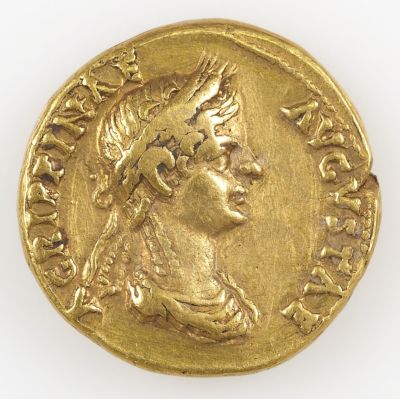
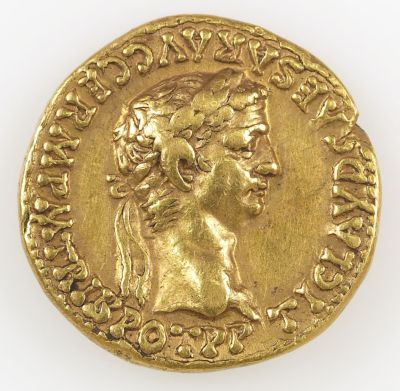
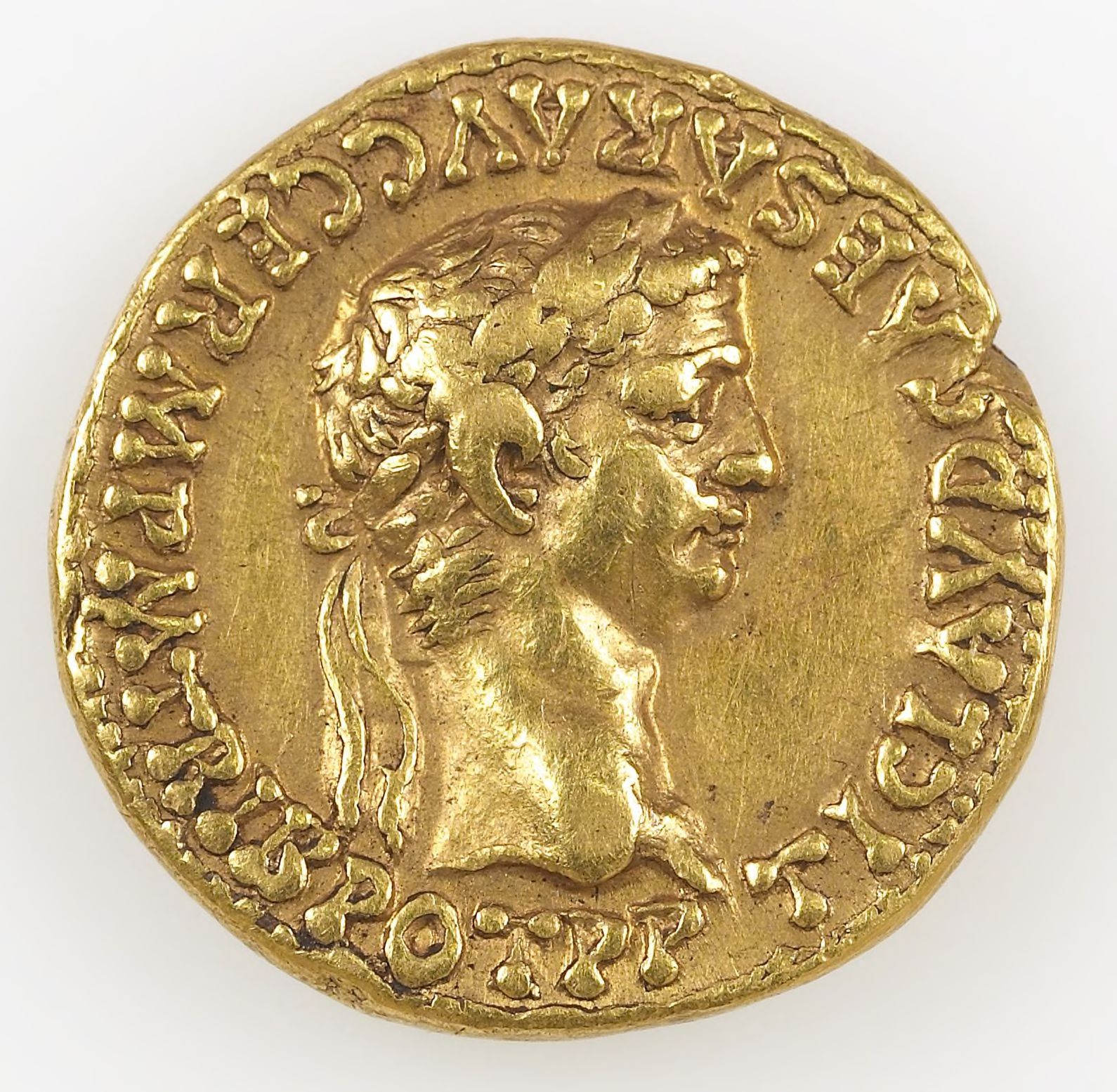
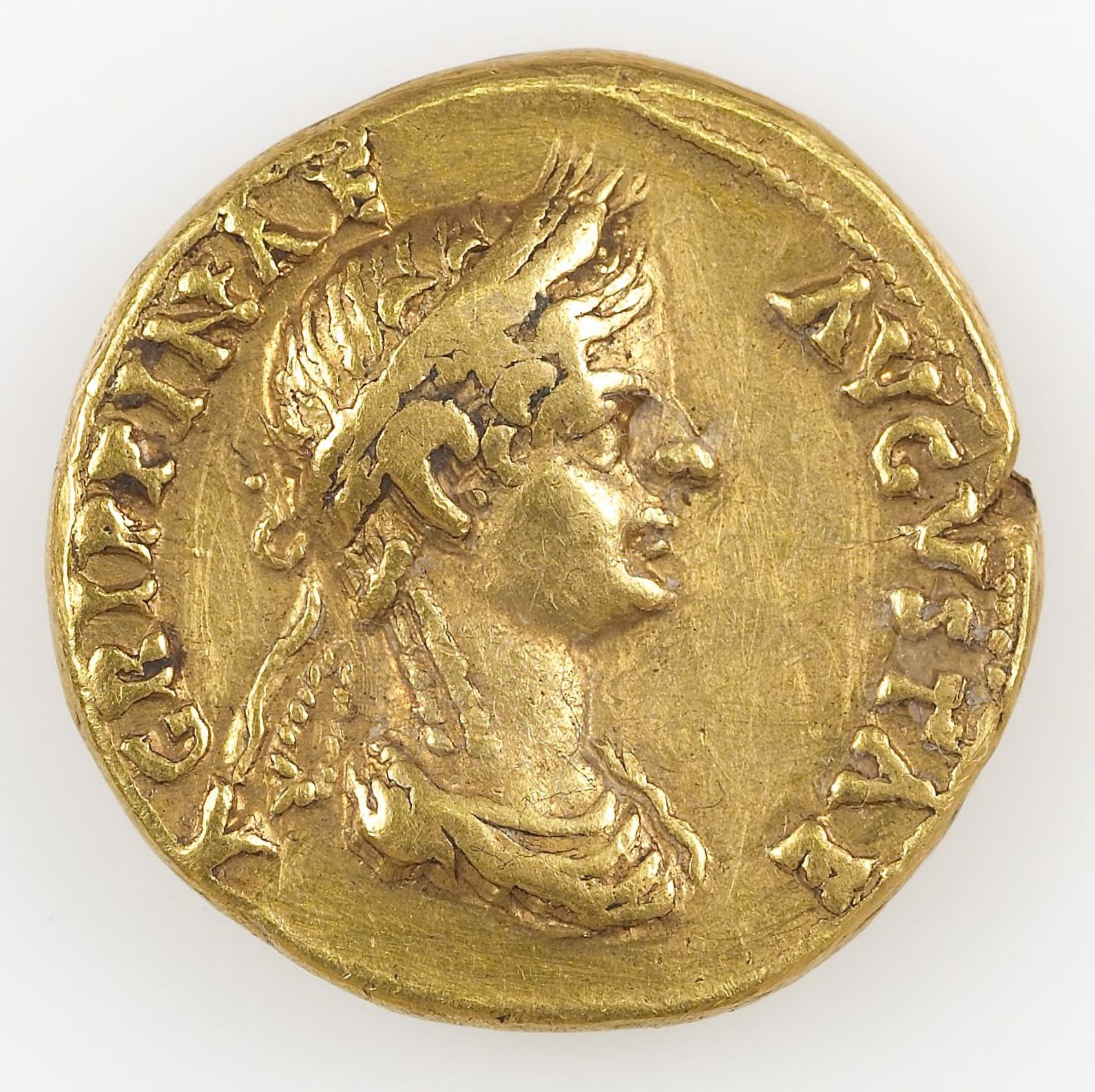
| Obverse: TI(BERIVS) CLAVD(IVS) CAESAR AVG(VSTVS) GERM(ANICVS) P(ONTIFEX)M(AXIMVS) TRIB(VNICIA) POT(ESTATE) P(ATER)P(ATRIAE) - Claudius head, laureate, right. (Full View) | Reverse: AGRIPPINAE AVGVSTAE - Agrippina bust, draped, right, wearing crown of wheat, hair in long plait behind. (Full View) |
An Introduction to the Essays on the Collection’s Gold Coins
John J. Dobbins, Professor of Classical Art & Archaeology
The University of Virginia’s numismatic collection contains, at this writing (2008), ten splendid gold coins ranging in date from the Hellenistic dekadrachm of the Sicilian tyrant Hiketas (287-278 B.C.E.) to the two late Roman solidi of Valentinian I (C.E. 364-375) and Valentinian II (C.E. 388), dating to the period after Constantine had moved the capitol from Rome to his “new Rome” at Constantinople. Between those extremes are the remaining seven Roman imperial aurei that span the arc of empire from the Julio-Claudians (aurei of Claudius and Nero), through the Flavians (aureus of Domitian), to the second-century emperors (aurei of Trajan, Hadrian, Lucius Verus), and finally to the Tetrarchy (aureus of Maximian).
The Roman coins from Claudius to Valentinian II cover a period of well over 300 years and evoke the aspirations of several dynasties and document various approaches to the organization of the empire. As works of sculpture they present fine portraits of many of the key players in the extended drama of the Roman empire. Using these nine coins as touchstones, one could narrate the whole history of the Roman empire from its beginnings to the point at which it evolved into Byzantine empire.
In this collection of Roman coins the dekadrachm of Hiketas is an outlier. It was purchased because it had a good provenance, was available, affordable, and above all, beautiful. As a Hellenistic coin it anchors the collection of gold coins in the Greek period and documents the influential Greek presence in Italy (Roman coinage owed a great deal to the coinage of the Greek cities in Italy). Although Hellenistic in date, the head of Persephone on the obverse is Classical in style. It is a fine example of Greek sculpture and forms an important point of reference for other coins in the collection.
As works of portraiture the nine Roman coins present many of the changing sculptural styles that appeared between the inception of the empire under Augustus and the late empire of the time of Valentinian I and Valentinian II. While aurei of the first three emperors are not present in the collection, Trajan’s “restored” aureus of Tiberius (Rome’s second emperor from C.E. 14 to 37) presents the idealized portrait style of the early empire. By the time that the aurei of Claudius and Nero were struck the pendulum had swung in the direction of more accurate renditions of the emperor’s appearance. Domitian belonged to the next, i.e., the Flavian, dynasty begun by Vespasian. Our aureus was struck late in his reign (he was assassinated in C.E. 96), but it masks any signs of aging and emphatically denies that the emperor was balding. Changing hairstyles are always part of the imperial portrait, and the aureus of Hadrian presents the new fashion for longer hair and a beard. The beard continued to be worn by the emperor until Constantine, in the early fourth century, broke with tradition, shaved his beard, and created a portrait that served as a precedent for the portraits of Valentinian I and Valentinian II.
Hadrian not only grew a beard, but also wore his curly hair longer than the emperors who immediately preceded him. That style set a trend, and the aureus of Lucius Verus depicts one of Hadrian’s successors with a very full head of curly hair and an ample beard. The “soldier emperors” of the third century wore close-cropped, military-style hair and beards and presented vivid countenances that displayed psychological depths rarely found in imperial portraiture. No gold coins of the soldier emperors are in our collection, but the sestertius of Maximinus Thrax ( C.E. 235-238) illustrates the style.
In the late third century Diocletian and his co-emperor, Maximian, brought to an end the chaotic period of the soldier emperors. Each emperor took a junior colleague who was to succeed him, the result being that the empire was controlled by a tetrarchy, or a rule by four individuals. The new tetrarchic form of government required a new portrait style that emphasized the harmony and cooperation among the tetrarchs. Consequently, most of the individual characteristics that are seen in the earlier portraits are erased from the portrait of Maximian who appears strong and powerful, but devoid of individual features that distinguish the emperors on the other coins (View Essay). Within our collection we cannot compare Maximian to his co-emperor, Diocletian, but such a comparison would show that the two appear to be nearly identical to support the idea of the harmony that existed between them. The portraits of Valentinian I and Valentinian II stand at the threshold of the Byzantine world. They look backward to the portraits of Constantine and forward to the icons, mosaics, and frescoes of the Byzantine period of the sixth century and later.
The essays on the gold coins are the product of a graduate seminar on Roman Numismatics that I offered in the fall of 2007. Each of the nine seminar members wrote an essay on one of the ten gold coins. Seminar members were Jared Benton, Katherine Boller, Robert Coleman, Nicholas Genau, Renee Gondek, Ethan Gruber, Stephanie Layton, Ismini Miliaresis, and Carrie Sulosky. In addition, seminar member Ethan Gruber designed the present website with the help of a grant from the University of Virginia Library.
Back to top